Unlocking the First Rune: Fehu, Wealth, and the Power of the Elder Futhark
PLEASE NOTE: THIS POST IS A.I. GENERATED FOR MY PERSONAL EDUCATIONAL PUPROSES!
If you’ve ever felt a pull toward the ancient, mist-shrouded history of Northern Europe, you’ve likely crossed paths with the Elder Futhark—the oldest known runic alphabet. Used by Germanic tribes from the 2nd to the 8th centuries, the word “Futhark” itself is a clever acronym, created from the first six letters of the runic alphabet: Fehu, Uruz, Thurisaz, Ansuz, Raidho, and Kenaz.
According to Norse mythology, the runes weren’t just a simple writing system; they were a profound cosmic language. The god Odin hung upside down from Yggdrasil, the World Tree, for nine grueling days and nights, sacrificing himself to himself, just to glimpse their secrets and lift them from the abyss.
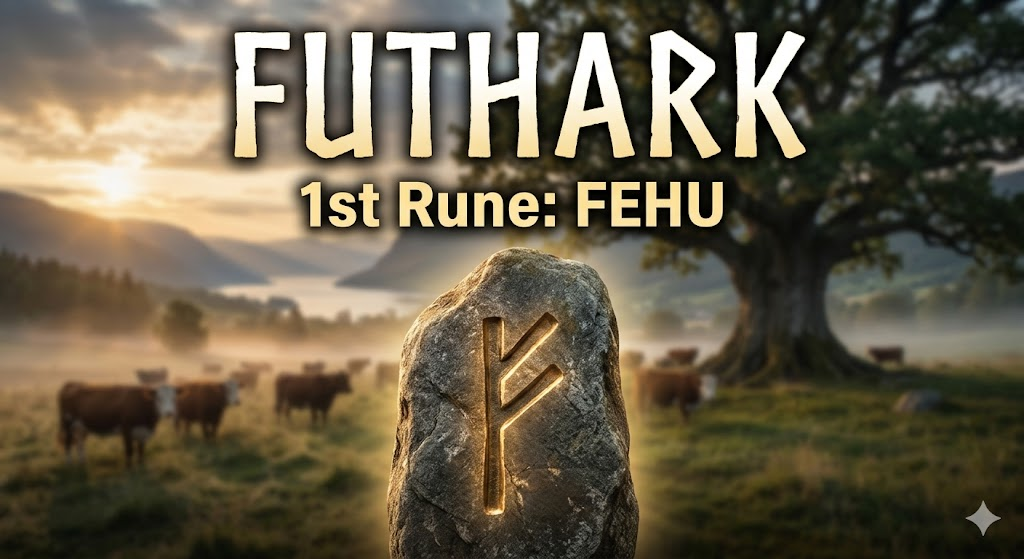
Today, we are diving deep into where that journey begins: the very first rune of the Futhark alphabet, Fehu (ᚠ).
The Anatomy of Fehu: ᚠ
- Phonetic Sound: “F”
- Literal Translation: Cattle
- Symbolic Meaning: Mobile wealth, prosperity, fresh beginnings, and primal energy.
Visually, Fehu resembles a standard Latin “F” with its arms pointing upward. Historically, these upward angles served a practical purpose—runes were designed to be carved into wood, bone, or stone, meaning straight and diagonal lines were much easier to score than curves. Symbolically, many view the lines of Fehu as the horns of a cow, reaching up toward the sky.
Ancient Context: Why “Cattle” Equaled Cash
To understand Fehu, you have to step out of the modern world of digital banking and stock portfolios and step into the mud of ancient Scandinavia. In the early Germanic and Viking ages, cattle were the ultimate currency.
If you had a large, healthy herd of cattle, you weren’t just a successful farmer; you were a person of immense social status, security, and liquid wealth.
Unlike land, which was fixed, cattle were mobile wealth. They could be traded, driven across borders, or used to pay a dowry. However, cattle also required constant vigilance. They could get sick, be stolen by rival tribes, or freeze during a brutal winter. Therefore, Fehu doesn’t represent lazy, stagnant wealth. It represents earned, active prosperity that requires work, responsibility, and protection.
The Dual Nature of Fehu: The Flow of Wealth
In modern esoteric practices and rune readings, Fehu is heavily associated with financial gain and luck, but it carries a vital spiritual lesson: wealth must flow.
Just as a herd of cattle becomes useless if you lock them in a dark barn and let them starve, energy and wealth must be actively circulated to retain their value. Fehu encourages us to use our resources generously and wisely, rather than hoarding them out of fear. It represents the primal fire that kickstarts a new project or venture.
How to Use Fehu in Modern Practice
If you are exploring runic meditation, divination, or modern symbolism, Fehu is an incredibly grounding yet ambitious energy to work with. Here are a few ways people integrate the first rune into their lives today:
- Mindset & Intention: Draw or visualize ᚠ when starting a new business venture, applying for a job, or setting financial goals to tap into that drive for tangible success.
- Meditation: Hold a Fehu rune stone in your hand to contemplate what “true abundance” means to you—balancing material security with spiritual richness.
- The Reminder: Let Fehu serve as a daily reminder that prosperity isn’t a passive stroke of luck. It’s a resource that requires dynamic effort, discipline, and a willingness to share the harvest.
The Elder Futhark begins with Fehu for a reason: before you can dive into the deep, chaotic waters of the cosmic mysteries, you first need to ensure your basic survival, security, and drive are firmly established. It is the spark that lights the fire for the remaining 23 steps of the runic journey.
Are you looking to study the runes for historical curiosity, or are you hoping to use them as a tool for personal mindfulness?